TO: Interested Parties
FROM: Climate Mayors Executive Director, Kate Wright and Bill Holland, VP of State Policy and Advocacy, LCV
MEMO: Mayors lay out plans to lower costs, drive clean energy
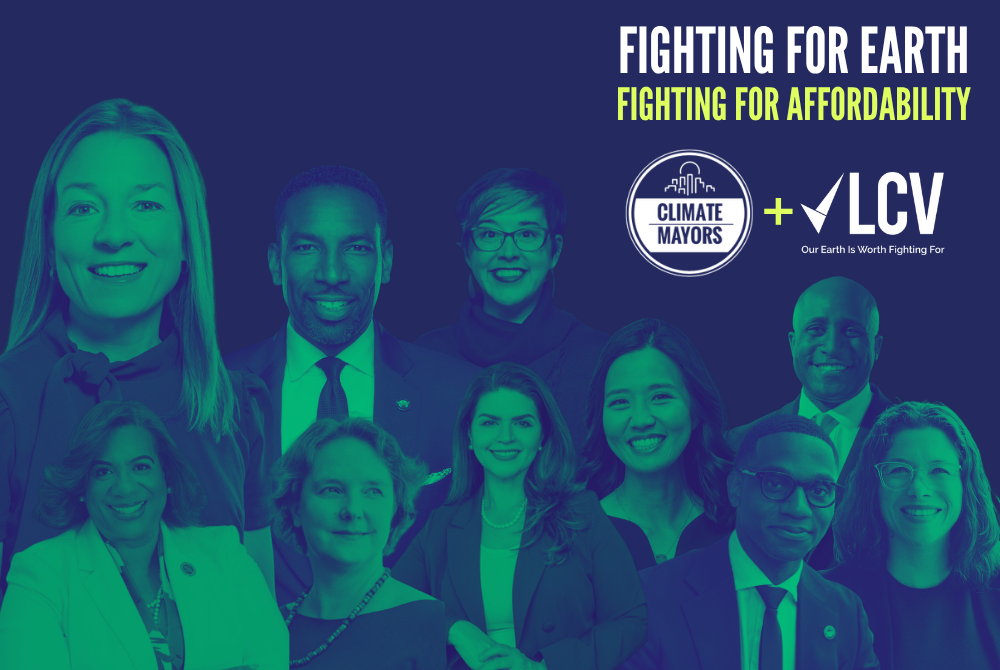
This Earth Week, Climate Mayors is partnering with the League of Conservation Voters to amplify the work of mayors who are investing in climate action and clean energy while delivering relief to the pocketbooks of millions of Americans.
Americans are feeling the impacts of the cost of living crisis and the climate crisis like never before. Energy affordability is reshaping how families experience the broader economy day to day, while rising utility bills and transportation are now one of the fastest drivers of inflation. The Trump Administration’s attempts to ban clean energy and the proliferation of big corporation tech data centers have increased energy prices for working families across the country. For many households, especially low-income families, these expenses compound already high housing burdens, leaving millions behind on electricity payments.
This vulnerability is deeply rooted in our nation’s continued reliance on fossil fuels and aging energy systems. For households already living paycheck to paycheck, particularly younger Americans facing rising vehicle, insurance and financing costs, these fluctuations can be destabilizing.
As the local leaders closest to their constituents, mayors are best positioned to deliver real change to improve people’s lives. Investments in local clean energy advance resilience while improving affordability and strengthening the local economy. Clean energy investments drive down costs for transportation and utilities while making homes more energy-efficient.
Climate Mayors are laser-focused on accelerating renewable energy growth at home to deliver clean, affordable, and reliable energy—faster. Clean energy is the quickest and cheapest way to bring new power to local communities. By implementing proven solutions—from efficiency upgrades and clean energy incentives to streamlined permitting and EV infrastructure—mayors are lowering energy costs and building healthier, more resilient cities. Here are some transformative solutions mayors are delivering to create cleaner, safer, healthier, and more affordable cities.
“Boise is meeting both our housing and climate goals by weatherizing homes in partnership with a local nonprofit, El Ada. Weatherizing homes is a direct investment into our community, by both preserving naturally occurring affordable housing and by ensuring that some of our most vulnerable residents are able to stay in their homes as the daily cost of living increases. In 2025, 123 Boiseans saw improvements on their homes that included fixing and repairing holes in roofs, replacing insulation, repairing heating and cooling systems, and more. Each repair plays a role in lowering energy bills, strengthening community health, and creating a more resilient city where everyone can thrive.”
“For too many Boston residents and small businesses, high energy costs are a burden that impacts their ability to afford other basic needs. Through the Boston Energy Saver Program, we are making it easier for families, small businesses, and nonprofits to cut energy costs, reduce their reliance on fossil fuels, and build a more affordable and resilient future.”
“Too many Atlantans are burdened with rising utility bills and higher costs of living across the board. These stresses can be linked to health disparities and negative impacts that have kept Atlanta as one of the nation’s highest energy burdened cities. To support energy affordability and its positive co-benefits, we launched WeatheRISE ATL. WeatheRISE ATL aims to reduce energy load for our most energy burdened households while also providing job training and contractor upskilling in weatherization and energy efficiency sectors.”
“With an initial $2.4 million dollar investment from federal sources, WeatheRISE ATL delivered impactful results. Community canvassers knocked on 5,482 doors and no-cost energy audits and healthy home interventions were provided to over 300 homes. To build upon this success, we established the Atlanta Community Energy Trust Fund. With residents seeking help to address rising utility bills and higher costs of living, the Atlanta Community Energy Trust Fund can invest in common-sense solutions that deliver tangible results. The initial $500,000 investment has already been matched with funding from the private and philanthropic sectors. The public-private-community partnerships like those amplifying WeatheRISE ATL demonstrate the best path to address energy affordability and create whole, healthy and climate resilient cities.”
“Climate Mayors understand that acting on climate and helping lower people’s energy bills are one and the same. Residents are asking for help with their household energy costs, and we are delivering through energy efficiency, smarter energy systems, and through rebates and other tools to help families improve efficiency in their homes. This is how we are creating a more affordable and livable city.”
“Here in Tucson, we are taking action. Under my leadership, our council allocated $900,000 to support the installation of solar systems in low-income homes through our Solar Empowerment Program. This investment is about more than clean energy. It is about lowering monthly utility bills for families who need it most and ensuring that the benefits of the energy transition are shared equitably. At the same time, this funding strengthens our local economy. Our nonprofit partners are on the frontlines, working directly with families, guiding them through the process, and installing these systems. As federal funding becomes more limited, these local investments are increasingly critical to sustaining their work and maintaining trusted community relationships. We know that energy policy is economic policy. By expanding access to affordable, clean energy, we are not only reducing costs for residents today, we are building a more resilient, equitable, and locally driven energy future for Tucson.”
“Energy costs are devastating families. Electricity and gas prices in Westchester are among the highest in the nation. This is why Mount Vernon is taking bold action on climate because it’s about affordability for our families. In partnership with Con Edison we are working to build a geothermal network, alongside investments in energy-efficient heat pumps, to lower and stabilize energy bills so residents aren’t forced to choose between staying warm and putting food on the table. Every dollar we save a family on energy is a dollar they can put toward groceries, rent, or their child’s education. Energy price stability isn’t just a utility issue, it is an investment in our local economy that strengthens families.”
“Energy performance contracting is a tool available to every single local government to get energy savings for city facilities, without having to rely on federal grant funding or burdening local taxpayers. In Cleveland, we are also layering in clean electricity investment tax credits for solar installations as an additional climate action toward our net zero carbon emissions by 2050 goal.”
“All of Madison benefits when we keep our city accessible to folks with a wide range of incomes. One way we can help is to reduce the cost of household bills, and we’ve launched multiple programs to do just that. Our MadCAP program gives a credit to low-income households on their Municipal Bill and encourages water efficiency. Our Efficiency Navigator program (run in partnership with Sustain Dane and Elevate Energy) supports energy efficiency upgrades in affordable apartment buildings, lowering utility bills for tenants while requiring that rents remain affordable. Our affordable housing programs require energy efficiency in new construction or major renovations, and our new social housing developments are utilizing geothermal heating and electric appliances instead of natural gas, improving public health and ensuring lower energy bills for tenants. We’ve installed over 2 megawatts of solar on our facilities, and all new City buildings must be at least LEED Gold, saving the taxpayers money. Energy efficiency eases the burden on folks who are struggling financially and helps keep them in their homes, and renewable energy helps buffer families from rising energy costs over time. Madison is working hard to meet our clean energy and affordability goals at the same time.”
“As Mayor, my top priorities have included climate action and affordability, and Burlington is seeking to be a climate-forward city. With the federal government eliminating key incentives for renewable energy and energy efficiency, in Burlington we are focused on continuing progress on our Net Zero Energy Roadmap goals, with key initiatives including Burlington Electric Department’s strong rebates for electric vehicles, EV charging, heat pumps, e-bikes, induction cooking, and so much more.”
“Research from Energy Action Network shows that Burlington drivers can charge an electric vehicle for the equivalent of less than $1 per gallon of gasoline. At a time when higher gas prices at the pump cost Vermonters over $15 million extra in March 2026 alone, helping more of our residents drive electric, and ensuring our community can be walkable and bikeable, is not just a positive from a climate standpoint but from a consumer affordability standpoint as well.”
“As Mayor I’ve also convened a group of climate advisors from across the City Departments as well as community members, and we will be issuing their recommendations for broader climate initiatives including ideas around resilience and adaptation efforts to protect our community, our lands and waters, and our infrastructure from the impacts of climate change.”
“Kansas City is focused on protecting our residents and their wallets from the material costs of climate change. In recent years, we have planted over 13,000 trees to support Kansas City’s urban canopy that keeps neighborhoods cool, clean, and beautiful as temperatures rise. Kansas City continues to distribute food recyclers that bolster our composting infrastructure and reduce food waste community wide. From innovative programs to energy reform, we remain focused on building a climate-resilient Kansas City.”
©2026 League of Conservation Voters