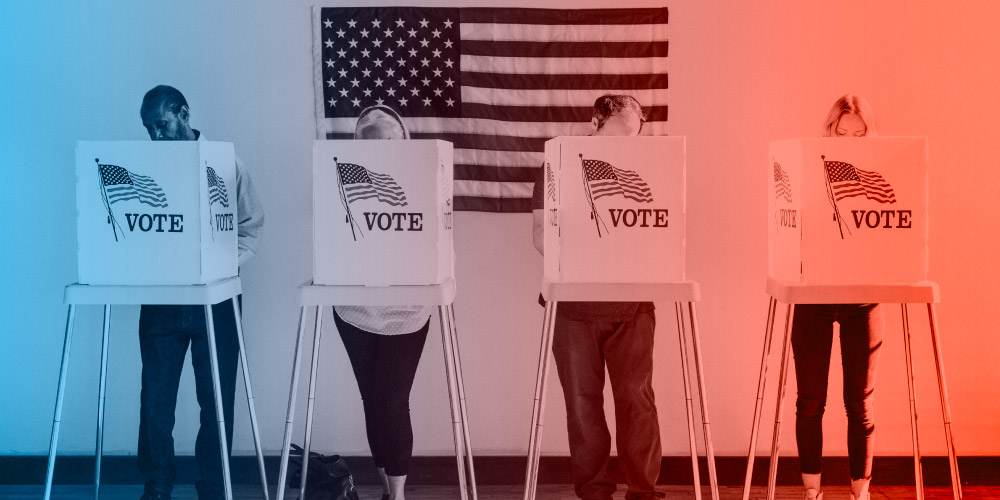
Nearly 9 in 10 prioritize lower energy costs and less pollution, signaling that candidates should make these issues central to their closing pitches
With the midterm elections two weeks away, a new poll of Black and Latino voters in seven battleground states finds that overwhelming majorities want candidates to address climate change, pollution and energy costs, even though those issues aren’t necessarily what voters name first when deciding who to support.
The survey, conducted by HIT Strategies for the Climate Equity Action Fund and the League of Conservation Voters (LCV), found that 72% of respondents selected the cost of living as one of their top three voting issues, followed by access to healthcare (42%) and discrimination (30%). By comparison, just 10% selected climate change and 7% who selected air and water pollution.
But when asked what candidates should prioritize, 89% said lowering energy costs was important and 86% said reducing air and water pollution was important.
The findings suggest that Black and Latino voters overwhelmingly want candidates to address climate change. With household costs and health taking priority, the poll underscores the importance of talking about climate policy in terms of what matters most to voters, including affordable energy, clean air and safe drinking water.
“Black and Latino voters haven’t tuned out climate. They see it in their power bills and in the air they breathe. Voters resoundingly care about climate when it is discussed in the real and immediate terms of utility costs and air pollution in their neighborhoods. It’s not surprising that the more disconnected the climate conversation becomes, the less it’s said to be a priority for voters of color,” said Andrea Cristina Mercado, President and CEO of the Climate Equity Action Fund. “Frontline organizations have known for years that when you connect climate to people’s bills and health, you build the majority it takes to pass climate policy.”
“People across the country are increasingly seeing the costs of rapidly rising energy prices, toxic pollution, and extreme weather fueled by the climate crisis, and Black and Latino voters know the impacts of environmental injustice on their communities,” said LCV National Field Director Bill Hairston. “These issues are deeply interconnected and top of mind for voters, especially voters of color who have been historically excluded. Voters have made it clear they want leaders who will protect their health, fight for clean air and water, build more clean energy to lower energy costs, and call out Trump and Republicans for causing energy costs to skyrocket.”
Nearly two-thirds of respondents (64%) said the outcome of the 2026 midterm elections would have a big or moderate impact on federal climate policy, while 68% said federal climate policy has a big or moderate impact on their own lives and communities.
The poll surveyed 2,003 Black and Latino registered voters in Arizona, Georgia, Michigan, Nevada, North Carolina, Ohio and Pennsylvania from Sept. 24 to Oct. 10.
The poll also found widespread concern about data centers and their impact on energy costs. Among respondents asked about the issue, 79% were concerned about data centers driving up energy costs, including 54% who were very concerned. Separately, 18% selected artificial intelligence and data centers as one of their top three voting issues.
Concerns about pollution were also widespread. Among respondents asked about safe drinking water, 85% expressed concern, while 84% said the same about having safe air to breathe. Another 85% expressed concern about having food that is safe to eat. About two-thirds of those asked were very concerned about each of those issues.
When asked which policies would do the most to reduce energy costs, 42% selected producing more clean energy, such as solar and wind, the most frequently chosen answer. By comparison, 15% selected expanding domestic oil and gas production through fracking. Respondents could select up to two approaches.
The survey also found that 48% identified President Donald Trump as one of the two parties most responsible for high energy costs, more than any other option. Republican elected officials followed at 20%, the federal government at 19% and utility companies at 15%.
The survey tested several messages intended to motivate voting. The highest-rated message emphasized clean drinking water, safe food and air while criticizing politicians for allowing corporations to pollute. Fifty-eight percent rated it highly motivating, giving it a score of 8 to 10 on a 10-point scale.
By the end of the survey, the share of respondents selecting climate change as one of their top three voting issues more than doubled. Air and water pollution as a top priority also more than doubled in priority order for voters who heard more during this poll.
About the survey
HIT Strategies surveyed 2,003 Black and Latino registered voters in Arizona, Georgia, Michigan, Nevada, North Carolina, Ohio and Pennsylvania from Sept. 24 to Oct. 10, 2026. The survey was conducted primarily through an opt-in online panel, with additional text-message recruitment to reach older Latino voters. Each state was weighted using voter file data, American Community Survey data and 2024 exit polling. HIT Strategies reports a margin of error of plus or minus 2.53 percentage points for the full sample.
###
©2026 League of Conservation Voters