The Supreme Court climate change case against Big Oil, Suncor v. Boulder, and what it means for you
Oct 2, 2026
As the Supreme Court heard arguments in the Suncor v. Boulder climate change case on October 5, a crowd rallied outside to protest Big Oil's attempts to escape responsibility. Credit: LCV
A major fight for climate justice against Big Oil arrives at the Supreme Court on Monday.The Court will hear arguments in Suncor v. Boulder, a climate lawsuit with high stakes for Americans’ wallets as they confront the costs of climate change. It’s no secret that fossil fuel companies knew their products would cause climate change. Taking a page from Big Tobacco’s and Big Pharma’s playbooks, they lied to the public for decades and made billions. With Suncor, the Supreme Court’s MAGA justices could help Big Oil avoid paying for it.
Suncor v. Boulder: the right to sue Big Polluters for climate change
This case will decide whether the American people and their local and state governments can sue Big Polluters for the harms of climate change.
Polluter-caused climate change costs American communitiesbillions of dollars. Across the country, a growing number of state and local governments are filing climate lawsuits against polluting corporations to hold them responsible for their share of the cost.
The story of Suncor v. Boulder starts with one such case. In 2018, officials in Boulder, Colorado sued fossil fuel companies for violations of state law. They say Boulder’s taxpayers are paying the price for Big Polluters’ greed. From wildfires to drought-induced drinking water shortages, climate change in Boulder poses many threats. Preparing for these threats and responding when they happen is costly. Boulder officials want the oil companies to pay their fair share.
Now, the MAGA justices will decide whether Boulder – or anyone else in the country – can even bring this type of lawsuit. If they side with the oil companies, then ordinary Americans could be stuck paying for the entire cost of climate change (the same way we’re paying for Big Tech’s data centers!). And the MAGA justices have a long record of making it harder for regular people to hold big corporations accountable in court.
How we all pay climate change costs
As the climate changes, communities face rising risks and climbing costs. Just a few examples:
When sea levels rise, flooding threatens people’s livelihoods. Homes, businesses, food, freshwater, roadways, bridges, and schools are all at stake. And repairs become ruinously expensive or even impossible.
All of this is before you count the rising costs caused by Trump canceling clean energy projects and starting a war with Iran. When disasters hit, states and localities face hundreds of millions, even billions, of dollars in damages. Meanwhile, fossil fuel companies try toavoid paying for the damage they’ve caused at every turn.
But the cost isn’t just financial. It’s personal.
People paying the highest price, and seeking justice
Peggie Fletcherfled her flooding home in Vermont on the back of a local firefighter in July 2023. With her, she carried four shirts, a pair of pants, a toothbrush, and her medication. She was one of thousands to lose their homes after rain fell at 300 to 500 percent of normal levels in a single week. Like Boulder, Vermont sued major fossil fuel companies for violating state law.
The heat dome covering the Pacific Northwest in June 2021 claimed the life ofJuliana “Julie” Leon, on what was then thehottest day ever recorded in Seattle. Her air-conditioning wasn’t working as she drove home from a doctor’s appointment in 102-degree heat. She pulled over, but was unable to call for help. Julie died of hyperthermia on the side of the road. Her daughter, Misti, sued oil companies in state court for wrongful death. A local government in Oregon also sued polluters over the heat dome.
A downed transmission line started a wildfirenear Paradise, California in November 2018. The Camp Fire destroyed an entire town, claimed 85 lives, and burned 150,000 acres. For residents to return home, the community had to rebuild roads, schools, and the sewer system. It also had to invest heavily in wildfire prevention and detection efforts. Eight years later, the town still hasn’t fully recovered. The Camp Fire is one of many wildfires at the heart of California’s lawsuit against oil companies.
When polluters may have broken the law, climate lawsuits are a critical pathway to holding them accountable. That is why eleven states, the District of Columbia, and 61 local and tribal governments have sued Big Polluters over climate change. A homeowners’ association and at least one individual have brought similar lawsuits. All rely on general liability claims under state law. They represent a tidal wave of Americans fed up with oil companies and their endless greed. This is why the fossil fuel companies are desperate to stop them.
How Republicans in all three branches of federal government are protecting Big Polluters
Now, these efforts to protect Americans from polluters’ greed are at risk. Polluter-backed Republicans in all three branches of the federal government are trying to shield polluters from liability. If successful, they would cut off peoples’ access to state courts as a means of holding polluters accountable. Even ordinary people like Misti Leon, who lost her mother to climate change, could be barred from suing for the loss of their loved ones, homes, and businesses.
The court battles blocking climate justice
Federal courts are battling over whether oil companies can be sued for violating state law. In New York City’s case, the U.S. Court of Appeals for the Second Circuit ruled for the oil companies. Yet, federal district courts in other circuits have allowed lawsuits to continue.
This term, the Republican-majority Supreme Court will decide the fate of these climate lawsuits and the right of other communities to bring similar lawsuits. Ruling for the fossil fuel companies would requirethe MAGA justices to make enormous leaps in their legal reasoning. However, several of the MAGA justices stand to benefit from doing so.
Most importantly, Alito’s recusal is unlikely to change the outcome of Suncor v. Boulder. The MAGA justices have the majority with or without him. And, Alito is not the only justice in that majority with ties to the oil and gas industry. Among others, Justice Clarence Thomas has joined many Supreme Court decisions in favor of fossil fuel companies. He is infamous for accepting extravagant gifts from billionaires. Among his many conflicts of interest are ties to oil company executives. Yet Thomas has not recused himself. As a result, the decision’s legitimacy is in doubt before arguments even begin.
Thus, Suncor v. Boulder is likely to join the long list of the MAGA majority’s landmark anti-environment decisions.West Virginia v. EPA severely undermined EPA authority to fight climate change under the Clean Air Act. Sackett v. EPA rolled back Clean Water Act protections for millions of miles of streams and tens of millions of acres of wetlands in the United States, jeopardizing the drinking water of millions of Americans. With Suncor, the pro-polluter MAGA justices are poised to strip ordinary Americans of their access to justice in state courts and give polluters free rein to continue destroying the climate.
The Trump Administration protects oil executives
The judiciary is not the only branch where Republicans are working to protect polluters from the people. In 2024, Trumppromised oil executives favors if they contributed to his presidential campaign. Oil-and-gas industry executives, PACs, and donor-advised funds donated $201 million to Trump and GOP campaigns, including ad spending. They also donated $19 million to Trump’s inaugural fund.
Then, Trump delivered on his promise. He has used the Department of Justice(DOJ) to protect polluters. In 2025, the DOJ sued Vermont and New York to stop their climate superfund laws. These laws would make polluters pay for the states’ climate adaptation and mitigation projects. In places with flooding, that could include turning parking lots into basins to hold floodwater. In communities experiencing extreme heat, updating paving materials on roads and creating more green space can help lower the temperature. In fire-prone areas, building more watchtowers helps detect wildfires early, saving lives. The administration is trying to block states from making polluters contribute to these efforts.
The DOJ has also sued to stop state and local governments, likeHawai’i, from suing oil companies in state courts. It has even intervened on behalf of polluters in Suncor v. Boulder. Outside the courtroom, gas prices are soaring while oil and gas companies post record-breaking profits in the tens of billions of dollars. But the Trump administration is paying billions of your dollars to cancel affordable clean energy projects. Those taxpayer dollars go straight to energy companies.
The Republican Congress offers Big Polluters blanket immunity
In Congress, oil-backed Republicans introducedthe so-called “Stop Climate Shakedowns Act.” The bill would give fossil fuel companies blanket immunity from state superfund laws and climate lawsuits filed in any court. That’s the same special treatment that Republicans on the Supreme Court are about to consider. The bill’s sponsors have deep ties to the oil industry. Senator Ted Cruz (R-TX) has long been a darling of the oil and gas industry. In 2024, he raised $1.4 million in campaign contributions from the fossil fuel industry. The oil and gas industry has given Rep. Harriet Hageman’s (R-WY) campaign hundreds of thousands of dollars.
The president and the Congress should be trying to protect regular people, not just the Big Polluters. And they should be trying to reform a Supreme Court that has been corrupted by Big Oil. Unfortunately, right now they’re not doing either.
Take action to protect us from climate disasters and polluter corruption
Again and again, Big Oil has lied and cheated to protect its profits. But everyday people have a right to make corporations pay for the destruction they cause. Our Congress, our judges, and our president should protect the people, not polluters’ profits.
Join LCV andtell your members of Congress: stop letting Big Oil off the hook! Make sure our judges work for the people and the law, not Big Polluters and their political allies.
Act Now
Tell your Senator: We need judges who work for us, not Big Polluters!
Again and again, Big Oil has lied and cheated to protect its profits. But everyday people have a right to make corporations pay for the destruction they cause. Our Congress, our judges, and our president should protect the people, not polluters' profits. Join LCV and tell your members of Congress: Vote no on Trump's pro-polluter judges and stop letting Big Oil off the hook! Make sure our judges work for the people and the law, not just Big Polluters and their political allies.

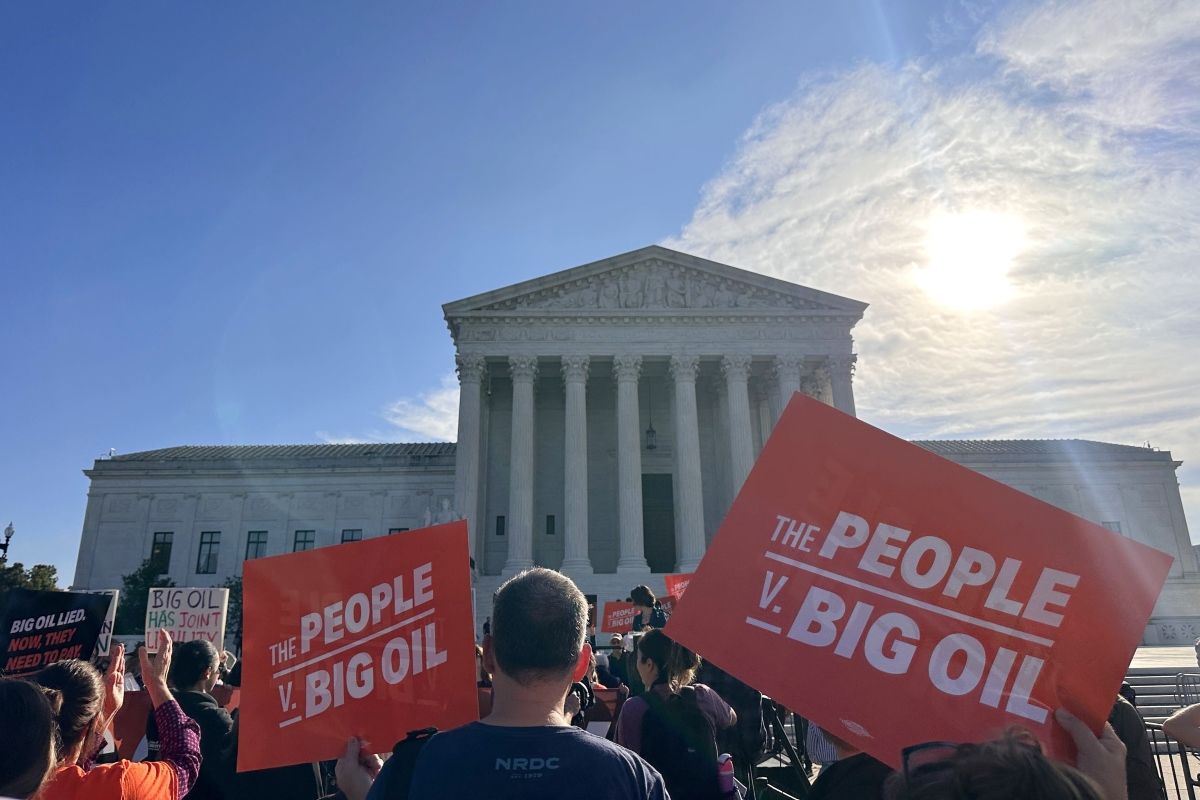 As the Supreme Court heard arguments in the Suncor v. Boulder climate change case on October 5, a crowd rallied outside to protest Big Oil's attempts to escape responsibility. Credit: LCV